Sunday, December 26, 2010

Conserve pure and rare breeds of poultry in 2011


One of my New Years resolutions is to promote a rare breed so I have started up an online free membership club named Java Breeders of America. Most of the clubs listed below involve rare breed heritage chickens.  If you raise a particular breed join a club today and assist and actively support that poultry organization. The aims and objectives of most Poultry Clubs are to promote high standards in the keeping and breeding of purebred poultry. I am also a member of the Wyandotte Club, Plymouth Rock Fanciers and the American Poultry Association.

Poultry Clubs have the following goals:
To conserve pure and rare breeds of poultry
To encourage, assist and advise domestic poultry keepers
To organize local and national shows
To provide show awards with medals, cash awards, and rosettes
To oversee the American Standard of Perfection and the introduction of new breeds and colors.

Poultry Clubs 
American Brahma Club
http://theamericanbrahmaclub.org
Contact: Club Secretary, Kim Aldrich
12948 Ring Rd., St. Charles, MI 48655
(989) 865-6702, email: kima53@ sbcglobal.net

Ameraucana Breeders Club
http://www.ameraucana.org
Contact: Michael Muenks, Secretary/Treasurer ,
Ameraucana Breeders Club , 33878 Hwy 87, , California,
MO 65018-3911, Phone: (573)796-3999
email: Michael@bantamhill.com

American Buckeye Poultry Club
http:/www.americanbuckeyepoultry club.com, American
Buckeye Poultry Club, P.O. Box 35, Williamstown,
KY 41097, (217) 417-0112, email: info@
americanbuckeyepoultryclub.com

American Buttercup Club
http://www.americanbuttercupclub.com
Bridget Riddle, Secretary/Treasurer, 3030 Orestimba
Road, Newman,CA 95360, 209-485-1413, email:
american buttercupclub@yahoo.com

The American Brown Leghorn Club
http://www.showbirdbid.com/ABLC
Bud Blankenship, 5205 Pundt Rd.
Lewisburg, OH 45338, 937-962-4226
email: budablc@hotmail.com

American Dutch Bantam Society
http://www.dutchbantamsociety.com
Secretary: Jean Robocker, 1655 Montford Rd.,
Kalispell, MT 59901, 406-756-6344

American Game Society, http://
www.americangamefowl.org, Contact: Anthony Saville,
Box 800, Belton, SC 29627

American Silkie Bantam Club
http://www.americansilkiebantamclub.org, Secretary:
Carina Moncrief, 23754 Spenser Butte Dr., Gavilan
Hills, CA 92570

American Sumatra Association
http://www.sumatraassociation.com
Secretary: Doug Akers , 300 S. 400 W.
Lebanon, IN 46052, email: dakers@ purdue.edu,
Phone: 1-800-chickens

Araucana Club of America
http://www.araucana.net
Secretary: Fritz Ludwig , 207 Pickens Drive, Pendleton,
SC 29670-9727
E-Mail:secretary@araucana.net

Belgian Bearded D'Anver Club
http://www.danverclub.webs.com
Secretary: Art Cosner, 11709 Cedar Ridge Rd.,
Williamsport, MD 21795
email: cosnerarthur@gmail.com

Belgian d'Uccle & Booted Bantam Club, http://
www.belgianduccle.org
BD & BB Club, 3490 Pruss Hill Rd., Pottstown, PA
19464, email: nniggel@ verizon.net

Canadian Araucana Society
http://www.members.shaw.ca/Canadian araucanasociety

Chantecler Fanciers International
http://www.chanteclerfanciersinternational.org, Secretary:
Mike Gilbert, W5171 Baker Rd., Holmen, WI
54636, email: info@redstagacres.com

Cochins International
http://www.cochinsinternational.cochins rule.com, Attn: Matt
McCammon, RT #2 Box 98M, Bloomfield, IN 47424
email: tomroebuck@cochinsrule.com

Dominque Club of America
http://www.dominiqueclub.org, c/o President, Eddie
Martin, 3740 Hwy 413, Anderson, SC, 29621

International Cornish Bantam Breeders Association,
Contact: Chris Tamayo, 9829 Falcon Meadow Dr., Elk
Grove, CA 95624, email: icbasectreas@gmail.com

International Waterfowl Breeders Assoc., http://
www.showbirdbid.com/IWBA, Secretary: Donna
Street, P.O. Box 216, Rockford, WA 99030, email:
Drcat2@aol.com, 509-999-4073

Japanese Bantam Breeders Assoc.
http://home.roadrunner.com/~jbba/JBBA.html
Secretary: Ken Lee, 6100 N Panda Point, Dunnellon,
FL 34433, email:mixer100@hotmail.com

Java Breeders of America, Ruth Caron, 
195 Northglen Lane, Martindale, Texas 78655
www.javabreedersofamerica.com

Modern Game Bantam Club of America, http://
www.mgbca.org
Secretary: Bonnie Sallee, P.O. Box 697
Pine Grove, CA USA 95665, email:
jbsallee@volcano.net
209-296-8084

Nankin Club of America
Secretary: Mary Ann Harley, 195 Macedonia Rd., North
Augusta, SC 29860

National Call Breeders of America
http://www.callducks.org
Secretary: Dennis Fuller, email:
wapsiwaterfowl@aol.com, 319-334-3497, Mail Memberships
to: NCBA c/o Steve Jones, 9677 Butler Lane,
Poetry, TX 75160

National Jersey Giant Club
Secretary: Robert Vaughn, 28143 CR 4, Pequot Lakes,
MN 56472

National Silkie Breeders Association
http://www.nationalsilkiebreedersassociation.org.
Secretary: Connie Bergquist, MN, premiersilkies@
aol.com
 
North American Hamburg Society
http://www.northamericanhamburgs.com, Secretary:
Jim LeGendre, 95393 Grimes Rd., Junction City OR
97448, email: legendre@efn.org, 541-998-3944
Old English Game Club of America, contact: Sam
Brush, 1009 Hillview Dr., Keller, TX, 76248, email:
slbrush@ verizon.net

Old English Game Bantam Club of America, http://
www.bantychicken.com /OEGBCA/index.html, Secretary:
Jennifer Wulff - Frank, PO Box 542, Connersville,
IN 47331, email: jenn5314@yahoo.com

Plymouth Rock Fanciers of America
http://www.showbirdbid.com/joomla/rockclub/, Secretary:
Robert Blosl, 14390 South Blvd , Silverhill, AL
36576, email:katz@gulftel.com

Polish Breeders Club
http://www.polishbreedersclub.com
Secretary: Jim Parker, 3232 Schooler Road,
Cridersville, OH 45806

Rhode Island Red Club Of America
http://www.showbirdbid.com/joomla/redclub, Secretary:
Frank Harris, 15483 Coatesville Rd., Beaverdam,
VA 23015, email: fbharris@earthlink.net
804-883-5682

Serama Council of North America
http://www.seramacouncilofnorthamerica.com

Rosecomb Bantam Federation
http://www.rosecomb.com/federation
Secretary: Steven Beaty
P.O. Box 126, Portales, NM 88130, email:
firemannm@msn.com, (575)-359-1074

Sebright Club of America
http://www.sebrightclubofamerica.info
Contact: The Bennett Family, 40 Old Taylorsville Rd.,
Shelbyville, KY40065

United Orpington Club
http://www.unitedorpingtonclub.com
Secretary: Christina Korfus , PO Box 681, Cle Elum,
WA. 98922, email: korfuskluckers@aol.com, 509-607-
0405

Wyandotte Breeders of America, New website is: http:/
/www.wyandottebreedersofamerica.com
David Lefeber, Secretary, 8648 Irish Ridge Road,
Cassville, WI 53806; Ph: 608 725-2179; Email:
dottestuff@yahoo.com

Wednesday, December 15, 2010

Wyandotte Club Secretary Wins at Shawnee

My newly found friend and fellow Wyandotte breeder, David Lefeber did great at The Shawnee Oklahoma Poultry show with 2 of his birds winning. I am posting 2 pictures of him and his beautiful birds. Please join the Wyandotte Breeders of America Club and help preserve this wonderful, friendly breed. The Shawnee show is a most go to event for lovers of the Wyandotte. There were hundreds of great birds there for your viewing pleasure. I was fortunate to meet several other members of the club and I must say they are dedicated folks that helped to run the Wyandotte club booth. Lets join together as a club and help to preserve this american class heritage breed.


Picture taken by Michelle Hernandez

Sunday, December 12, 2010

Shawnee, Oklahoma 2010


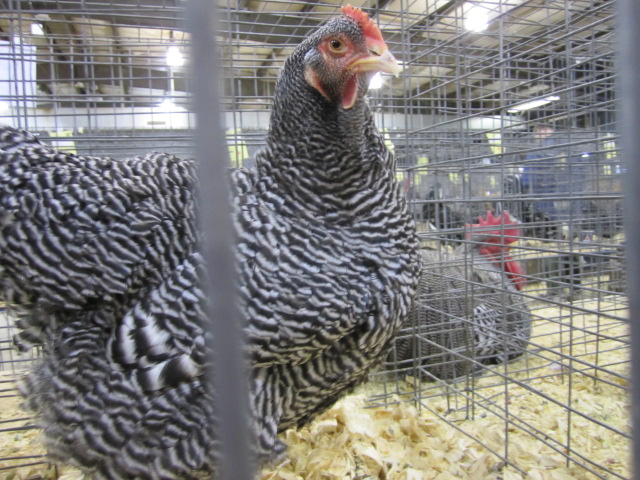
If you are interested in raising Heritage Barred Rocks here are some pictures of Barred Rocks that were entered at The Shawnee  APA Nationals. I have not listed the owners names they are just to give you an idea of what decent Barred Rocks look like. I would recommend joining The Plymouth Rock Fanciers Club and getting a Standard of Perfection Book.


Wednesday, December 8, 2010

Correcting Faulty Feather Quality


Bad care can ruin a good chick 
One of the first things I notice on a bird is its feathers. Are they clean, healthy, and delightfully formed and above all do the color and markings jump out and say, I’m beautiful! Look at me? Feathers and their quality can make or break a bird. Faulty feather quality can be attributed to filthy living quarters, over crowding, lack of proper nourishment, poor breeding and anything else that hinders the progress of feather development. Don’t get me wrong, good care will not convert a poorly bred bird into a champion, but the lack of proper care will pretty much ruin the finest chick ever bred. Skimping on feed quantity and quality and lack of clean water can be the main culprits. Overcrowding causes birds to pick on each other and we all know about pecking order, as it is rightfully called.

1.                Texture: Plumage must also have the proper texture called for in each specific breed. This characteristic of the feathers may also differ in different breeders lines.  A certain amount of hardness of feather is necessary if a smooth surface is to be obtained. A loose, abundantly feathered bird has a softer, fluffier appearance in its feathering. If a smooth surface is what you desire, make sure and select a cock, with lustrous plumage and whose breast feathers are hard and smooth. Breed him to a hen with that is fluffy and well cushioned.

2.                Shape: Each feather has to have the correct shape for the specific area of the body it is on and must be inspected to see that each individual feather is tightly joined together all the way to the edge. A cock should also carry a large amount of webbed feathers in the fluff of his body (Of course this does not apply to Silkies or other similar feather types). Roosters can be poorly shaped due to not having the proper plumage. The back may be flat because the plumage of the saddle does not build up a concave sweep to tail. I also would recommend breeding him to a fully feathered cushiony female to alleviate this problem. High tail feathers in the male may be corrected by breeding from low tailed females with well spread main tail feathers. 

Important details to remember in selecting birds for breeding good feather quality...


  • Some feather defects may be bred out by breeding to a bird with the opposite that you desire 
  • Heavy culling for the best birds
  • Selecting good breeding stock from the start
  • Carefully researching the breeder before you buy
  • Visiting poultry shows and buying from winners
  • Last but not least take good care of your birds

Tuesday, December 7, 2010

Successful Poultry Breeding


Blue Laced Red Wyandotte chick
The fine art of poultry breeding is extremely fascinating and there are many intricate details that need to be carefully anticipated. Though we can learn much from experience, we can learn alot more things quicker from reading. Details and tips that would of taken us years to learn from costly experience are readily available for us in books and in articles written by others who have carefully researched and have taken the time to document it. There are many, many secrets in regards to the breeding of poultry and following the guidelines outlined in The American Poultry Association's standard of perfection. One of the most important secrets is how to mate to produce birds that are of extreme merit in size, shape and color. Very important is the fact that the cock at the head of the breeding pen should be symmetrical in shape, strong, and vigorous. He will also need to be the offspring of a cock exhibiting the same fine traits. Remember that it is the male bird which has the greatest influence on the color of the chicks, especially of the cockerels. If finely colored males are desired it is necessary that the cock be of very fine color. Always remember "What you have is what you get". By mating a good sire to his own offspring the good breeding qualities of the parent bird will be passed along to the chicks. Color and other desirable qualities may be intensified by strict inbreeding. Please realize that if an error is made in the selection of the breeding stock undesirable traits may be inherited. It is believed by some breeders raising poultry that they must introduce a new bloodline from a different strain each year. By doing this they go backwards instead of forwards. Noticeably every breeder's birds are different in style and feathering. When these two different bloodlines are mixed some of the young may look like the cock and there will be some that will look completely different, unlike either parent. The second season such breeders usually get a male of a still different type and mate him to the pullets of different types. The result is that they have no good birds among the offspring, and hardly any two chicks resembling each other. If you get what you want from a reliable breeder stay with that breeder. The hen should possess a strong constitution, prolific laying qualities and large size. We look to the hen to impart size to the offspring. She must have great coloring in her feathers, legs and beak. Her ear-lobes and comb must also be carefully examined. Most importantly is she should be symmetrical In shape. Many times the breeding qualities of the hen are overlooked or underrated, which is a great mistake. 

After carefully selecting your stock for the  breeding pens it is essential that your birds receive proper care and nutrition. Always give them fresh water daily and greens as often as possible. Chicks need to be closely monitored and carefully tended to from the time they leave the shell until they reach full maturity. This is another secret in successful breeding that apparently Is only known to a handful of poultry enthusiasts.

Saturday, December 4, 2010

WyanDottes and Rocks: Blue Wheaten Ameraucanas

WyanDottes and Rocks: Blue Wheaten Ameraucanas: "I have a fine line of Blue Wheaten Ameraucanas that were purchased from a well known breeder in Missouri. The way I obtained them was quite ..."

Monday, November 29, 2010

White Plymouth Rocks

THE ORIGIN AND EARLY DEVELOPMENT

From the first, White Plymouth Rocks came as white chicks from Barred Plymouth Rock parents. This departure from the general appearance, expected according to the laws of heredity, has been variously explained.

THEORETICAL EXPLANATIONS

Atavism

One claim is that it is due to a phenomenon known as "atavism." This phenomenon consists in the recurrence in a descendant of characters that were possessed by a remote ancestor, instead of characters found in an immediate or near ancestor. The word is derived from the Latin atavus, which originally meant the father of a great-great-grandfather, but which was later applied to any remote ancestor. This tendency of ancestral characters to reappear in offspring, either immediately or after laying dormant for several generations, is due to a mysterious vital principle known as heredity. If the qualities appear after a long dormancy, the heredity is atavistic. Atavism implies that the recurring characteristics were actually found in a remote ancestor or in several of them ; otherwise, their appearance would not be a manifestation of heredity, but of an effort without a cause an ''absolute commencement."

Possible Influence of Black Fowls

However, in the attempts to account for white chicks from Barred Plymouth Rocks, other theories have been propounded. It was even suggested that they resulted from the influence of Black Java or Black Cochin whichever may have been ancestors. This theory, however, is in contravention of the well known laws of heredity; unless, indeed, it is a case of atavism from a white ancestor far back along the line of descent of the Black Javas or Cochins.


The Influence of White Fowls

Another explanation is that white fowls known as Birminghams were the determining factor, upon the supposition that they had been bred into one strain, at least, of Barred Plymouth Rocks.

Edward Brown's Explanation

Still another and quite reasonable explanation is that offered by Edward Brown in "Races of Domestic Poultry," page 153, as follows: "This breed is a sport from the Barred variety. It is easily seen that a failure of pigments, so far as the black marks are concerned, would yield white plumaged fowls, and wherever we have the mixed markings, which is sometimes known by the term "cuckoo" there will occasionally be specimens which either show pure white on the one hand, or are entirely black. It is in this way that many of the varieties have been secured, and the tendency to variation is very great in every kind of poultry."
 
D. A. Upham's Statement

The following facts would substantiate Mr. Brown's explanation. As first bred, Plymouth Rocks came with the males very light and females very dark in color. We have Mr. Upham's statement that most of the pullets of the Spaulding cross were black and all the cockerels grey, but that he succeeded in finding a certain number of grey pullets to go with a grey cockerel he selected. Rev. D. D. Bishop in his book, "The Development of the Plymouth Rock," calls attention to the light males and darker
females as "the law of Dominique color" and makes this statement: "The most important and striking characteristic that presents itself to a student of Plymouth Rocks is the peculiar difference in the color effect in the two sexes. First, last and always the males come lighter than the females. It is a thing
we must never forget in dealing with this breed. It will beat us if we do but we shall never beat that. It is in the birds, it is the law of this color that the males will not only be several shades lighter in color, but the width of the bars wi1 ! be about one-third of the light spaces between them. It is a very light
pullet that has the space between the bars equal in width to the bars themselves, and from that the spaces grow less all the way down to no space at all, or solid color.

The Editor's Experience and Observations

Moreover, the fact that males from the same matings, even though the matings be restricted to pairs, are of much lighter shades than the females is known to all those who are in the least familiar with the characteristics of Barred Plymouth Rocks. This difference was, in the recollection of the writer, much greater in years past than at the present time. It is, then, reasonable to suppose that in their endeavor to get the females lighter, which endeavor naturally followed where too dark females were in the majority and even black ones sometimes appeared, lighter and lighter matings were used. In fact, within the Editor's recollection, males nearly white in color were used by breeders in their efforts to produce
exhibition pullets of the desired shade. The result was what might have been expected, a few white chicks. As an instance of such an occurrence, a certain mating of Barred Plymouth Rocks made by the Editor in 1895 produced five white chicks, four cockerels and one pullet. During the season, following the advice of a prominent breeder, the male had been changed. No white chicks were produced by the first male, a much darker one than the second, which was very coarsely barred and very light colored. The year previous, the writer saw three white sports in the yards of Mr. D. J. Lambet, of Rhode Island, well known as a breeder of Barred Plymouth Rocks exclusively. The same year another prominent breeder won first, fourth and fifth on White Plymouth Rock cockerels which he said were sports from his Barred Plymouth Rock pullet matings. The Editor assisted him in showing these birds, and
that they were found in the same flock or pen as the pullet breeding Barred Plymouth Rock males, he can attest. Furthermore, these spirts were of the same strain as the five bred by the Editor. That white sports did occur from the lighter or pullet matings was well understood by the breeders of Barred and
White varieties of that period. This much can be noted all species or nearly all have produced an albino, some frequently, others very rarely. An albino from Barred Plymouth Rocks is, for that reason alone, not to be considered an improbability, even though a white ancestry is not proved.

FACTS ABOUT THE ORIGIN


The Originator

The credit for having originated the White Plymouth Rocks has been accorded to Mr. Oscar F. Frost of
Monmouth, Maine. This has been, perhaps, because he was the first to proclaim their appearance. Directly following his admission of their existence, other breeders began to report their presence in their flocks. One breeder in Indianapolis wrote to me prior to 1876, telling of the hatching of white chicks from Barred Plymouth Rocks. I went to see them and induced him, quite against his will, to mature and mate the white chicks. The greater part of all the white chicks obtained from the Barred
Plymouth Rocks came from the Essex or Drake strains, originated through the union of several kinds of fowls.

An Early Account

From "Barred and White Plymouth Rocks," by Joseph Wallace, 1888, we obtain in substance the following account of the foregoing occurrence. Mr. Frost received a pair of these White Plymouth Rocks (sports of Barred Plymouth Rocks) of a neighbor who was breeding the Essex strain of Barred Plymouth Rocks. These he bred the first year and according to several accounts he had a poor looking lot for some years, but finally succeeded in producing very fine flocks of fowls. According to some authorities quoted in that work, 1878 is the date that Mr. Frost started to breed them, though it is generally thought that white sports from Barred Plymouth Rocks had not been an infrequent occurrence. The same author pays this nice tribute to the new variety : "The mind cannot conceive of a more handsome and appropriate companion for the Barred Plymouth Rock than the White Rock. Often in our boyhood days, while reading the stories of Sinbad, the Sailor, in the 'Arabian Nights' Entertainments,' we pictured to ourselves the size, strength and power of flight of that formidable and fortuitous bird, the White Roc, that was capable of lifting elephants from the plains, that rescued so many travelers, heroes, cast-aways and adventurers from the jaws of death, and carried them in its huge talons over seas and mountains to other lands, where pleasure, wealth and beauty
awaited them. Little did we think then that the day would come in our time when the great White Rock of the western world would carry off thousands at a time, not in its talons, but in admiration of its grandeur, beauty and usefulness."

Clamor for Recognition. 

Directly following the public announcement of the presence of these fowls, there was a persistent
clamor for recognition as the originators of them, and for the right to name them. This claim was conceded to the person who could prove that he was the first to see and breed them. They were variously named White Plymouth Rocks, Puritans, Dirigos, and other names for the less important strains. The real strife for supremacy came when admission to the Standard of Perfection was sought for them. Then began their official existence, as told in the records of the proceedings of the Indianapolis meeting of the American Poultry Association, January, 1888.


RECOGNITION BY THE AMERICAN POULTRY ASSOCIATION

The Committee on New Breeds reported to the convention Wednesday morning, January 25, 1888, that they would recommend the admission of the White Wyandottes, White Plymouth Rocks, White Minorcas, White Javas and Dirigos. As to the fundamental difference between White Plymouth Rocks and Dirigos, George P. Coffin, of Freeport, Maine, writes as follows : "Replying to your letter of May the 28th, would say the first White Plymouth Rocks that I knew of were those bred by Mr. Oscar F. Frost, Monmouth, Kennebec County, Maine, who is generally considered the originator of the breed. As early as 1880 these were called White Plymouth Rocks, as I remember of my father having some of them when I was a small boy. While I am not positive about the matter, I incline to the belief that the Dirigo was the same strain of birds. The name, Dirgio, which is the motto on the State seal of Maine, would indicate the breed to be of Maine origin. At that time the idea of sports had not come to be understood and there were many of the breeders who doubted the sport origin of the breed. At the same time, as often occurs when a new breed is in the making, others besides the originator attempted by cross-breeding or in other ways to produce birds with similar characteristics, yet with different or partially different blood lines, and then, as sometimes happens, if these birds are bred with the originator's stock, it makes it much more difficult to trace the breed history." Other breeds and varieties were included in that report, a little of which should be mentioned here. The presentation of five new varieties of white fowls for admission to the Standard was a matter of vital importance, and there was considerable opposition to the admission of the White Plymouth Rocks, the Dirigos, and the White Javas. This was because it was plain that there could not be so many kinds, all true to breed characteristics. Ultimately, White Wyandottes, Golden Wyandottes, White Plymouth Rocks, Jersey Blues, White and Black Minorcas and Pea-comb Plymouth Rocks were, all of them, admitted to the Standard under one resolution. Later, a resolution was offered asking for the admission of the Dirigos to the Standard, although they were the same as the White Plymouth Rocks. A memorial was presented to the meeting demanding their admission, and great claims were made for their qualities. An argument developed the fact that Mr. Ferris had first shown these fowls in Bangor in 1875. They were judged and admitted to be the first White Plymouth Rocks ever shown. They came frcm the farm of Mr. Ferris, this being called Dirigo Farm. Mr. Beal, Mr. Ferris and others claimed the credit of originating the fowls and the right of naming them. An attempt was made to read the memorial. This, however, was denied and the document was never admitted to the records of the meeting. I now regret that it was not preserved, although at that time I objected to its admission to the record. It would doubtless reveal some interesting facts concerning the origin of this fowl. The objection raised to the admission of all these fowls was that they had been shown as three separate breeds White Plymouth Rocks, White Javas and Dirigos whereas they were in reality three separate strains only. About the only difference
between them was that the White Plymouth Rocks and Dirigos had yellow shanks; some of the Javas had shanks of willow color like those of the Game Fowls ; still others had yellow shanks. By agreement, both the White Plymouth Rocks and the White Javas were admitted, the White Javas to be disqualified for shanks of any color but yellow. The White Plymouth Rocks were required to have yellow shanks. These disqualifications supplied a method for and influenced a speedy separation
between the two. The White Plymouth Rocks have improved continually since their admission to the Standard, while the White Javas have become obsolete.
 
The Result of Recognition

The admission of so many white varieties to the Standard of Perfection was the signal for unusual activity among those who bred white-plumaged fowls. This influence extended even to turkeys, ducks and geese. So much was written about them that many who had kept or were keeping other fowls forsook them, and turned to the breeding of white-plumaged fowls. The advocates of the White Plymouth Rock were so ardent and so apt in presenting the merits of that variety to the public that there was a general reaction in favor of them During the years that followed, many efforts were
made in behalf of other varieties, but in the melting pot of public opinion, the White Plymouth Rock has continued to gain until its true value is recognized in every land. It is certainly true that there is no one best breed or variety of fowls ; the best for all is the kind best suited to the needs and pleasure of the one who selects them. The real quality of any breed or variety has been, and will continue to be, built up by the energy and skill of those who breed it. Those who have chosen the White Plymouth Rock have chosen well. They have succeeded in satisfying their ambition as well as in gaining the favor of the general public. However, no one breed or variety ever gains unchallenged supremacy, although the White Plymouth Rock has become a favorite as a fowl for exhibition, for table purposes, and for profitable egg production. (T. T. McG.)

taken from The Plymouth Rock Standard Breed Book