Monday, March 7, 2011

South Texas Classic 2011

Silkie
The South Texas Classic in La Grange Texas was March 5th at the Fayette County Fair Grounds.
The Judges at the show were Monty Fitzgerald and Troy Jones. This was a spring show so it was smaller than the usual fall/winter shows. But it was a great show filled with great chicken peeps, and I had a great time. I went with 2 of my friends who also went to see the show and had hopes of buying breeding stock that they needed and were in luck. For lunch we drove into the nearby town of LaGrange (home of ZZ Top) and ate at a small cafe. The food was great, and the people in the cafe must of thought we were all crazy because we were all talking about chickens while we ate.

Game Rooster
Seabright
Dark Cornish pullet
Silver Sussex

Monday, February 21, 2011

Chick Season is upon us

Chicks live in brooders like these outdoors

Baby Welsummers Ruth Carons line
It is important to keep your new baby chicks warm and free from drafts. They will also need to be properly fed and watered, and be protected from predators. A 95 quart Rubbermaid plastic bin can be a satisfactory home for up to 20 newly hatched chicks. The size and shape of the bin is not as important as long as it provides enough space for the chicks and the equipment to feed and water them.  Next I take the lid and cut out the center leaving a 2 inch edge and attach chicken wire with plastic ties.This is to protect the chicks from cats and other predators. The sides of the box provide adequate protection from drafts. Next I place a brooder lamp on top and use a 65 watt light which is adequate if your chicks are kept indoors in a heated room. Make sure that the lamp is attached safely so it won't be a fire hazard. During the 1st week the temperature should remain at 90-95 degrees. As the chicks get older reduce the temp by 5 degrees a week. When the chicks are cold, they bunch up and give off a distressed chirp. When they are too warm they will pant with their mouths open. I use rubber shelf liner the first few days so that the chicks can get a firm grip as they walk. After that I use old newspaper and change it out every day. Make sure the paper does not have a strong ink smell. Be sure to change their water twice a day, or more frequently if necessary to keep the water clean and fresh. Clean the waterer each time you make the change, and refill it with fresh slightly warm water. Although chicks don't need feed or water the first 48 hours after hatching, both are usually provided as soon as the chicks are transferred to the brooder. I use a small dish the first few days for a feeder. Let the chicks scratch around in the feed for the first few days so they get off to a good start on the feed. Chicks are best started on a 20 percent chick starter mash. Remember the better you feed your chicks the healthier they will remain and they will also grow faster. When the chicks are approx 4 weeks old I transfer them outside to an outdoor brooder. Once again this all depends on the weather and time of year.
Java Chicks from Duane Urch
Rhode Island Reds from Duane Urch
Golden Laced Wyandottes from Duane Urch

Thursday, January 27, 2011

How to effectively breed showbirds by spiral breeding

Silver Laced Wyandotte Cockeral

Sure one trio or a foursome is a good start, but to make progress faster, set up 3 breeding pens (in this article a breeding pen is a trio or a foursome). Pick out the best birds that you can and look them over carefully referring to the Standard of Perfection (SOP). They do not need to be perfect (but as close as possible). Eliminate obvious defects, such as wry tails, deformed toes or beaks, wrong type of comb, poor coloring, poor type, poor size or weight, slipped wings the list goes on. The trios should be all from the same line. Keep track of everyone with bands and write down all your info into a journal. Differentiate between the trios with letters, numbers or colors. Always cull down to the best out of each hatch.

• Pen number 1(A) or line 1 is banded with a 1 or (A)
• Pen number 2(B) or line 2 is banded with a 2 or (B)
• Pen number 3(C) or line 3 is banded with a 3 or (C)
• If you don't have bands use plastic ties that are colored, but keep each trio with its own
unique identifying marker. Their children need to be marked accordingly. From birth. You
can use a toe punch to mark the offspring. Also make a family tree for your trios. If a parent is unknown write unknown. If a bird looks good and its lineage is unknown that's O.K. What matters is that the bird looks good. Make sure to mark your eggs according to the parents and keep them separated in the hatching tray. They should be toe punched asap (see chart below). Once all breeding pens are set up and the birds are marked follow the instructions below.

Silver Laced Wyandottes
 For Season 1, mate all males to females of their own line. 
From your first hatch the best Daughters of Season 1 are added as breeders to the line that produced them (they stay with their mothers.) This is why you toe  punch the young so that you will know which daughters came from which mothers. (Sons are compared to their fathers for quality and only the best are kept in a bachelor pen until needed). A bachelor pen is a separate pen for all your roosters that are not being used.
In Season 2, mate the 3 or C line male to the 2 or B line females, mate the 2 or B line male to
the 1 or A line females, mate the 1 or A line male to the 3 or C line females - rotating them.

Females from Season 2 are added to the line that produced them alongside
their mothers. The best son of the 3 or C line male mated to the 2 or B line females is
kept and mated to the 2 or B line females; same for other matings, old cocks are
retired.
Once everything is going well males are used twice, then retired and replaced by a son. Males rotate one line over every other year. This gives you a year of out cross and a year of line breeding.

You will need
  • • at least 3 different pens
  • 3 different trios of birds of the same variety
  • • Leg or wing bands
  • • toe punch
  •   a detailed journal book

Toe Punching

A toe punch is a small tool used to make a tiny hole in the web of a chicken or other fowl's foot. There are two webs on each foot and two feet on each bird for a total of 16 possible combinations for each variety. See chart below for the different combinations.

Monday, January 24, 2011

Welsummer chicks in the house

My first Welsummer chicks of 2011
Today I hatched 6 Welsummers from my Don Gibson line of Welsummers. They are very hardy chicks and the eggs they hatched from were large and a beautiful Terra Cotta color. I have a trio of parent birds that I purchased at the Shawnee, Oklahoma A.P.A National show. My rooster Cornelius was Best of Breed and the hens placed third and fourth. I called Don today and told him that I was a proud mom of some baby Wellies. They are very healthy birds just like their parents. I found out from Don that these birds originated from a man out of Kansas named Gary Cooper. I think I have a very good strain of Welsummers and I plan on hatching every egg my trio lays and use them for my breeders. I have a lot of eggs in the GQF. I say Welsummer chicks in the house because they are literally in the house. I also hatched 7 Barred Plymouth Rocks from the trio I purchased at Shawnee from John McDaniels. He had some great Barred Rocks and placed well with them. I am keeping them separate from my other line of Rocks that I purchased from Jeremy Woeppel (Frank Reese line).

Tuesday, January 18, 2011

More beautiful pics I snapped at the Bluebonnet Classic

APA Judge Marty McQuire

Reserve Champ Game Class Black Sumatra
Champ Game Class Black Sumatra pullet
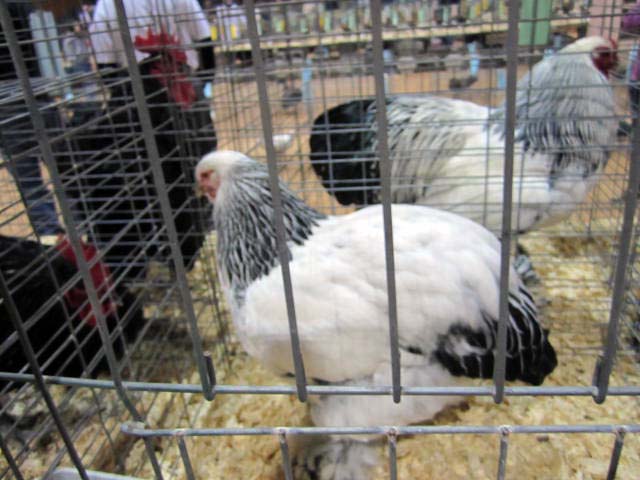
Reserve Asiatic Class champ pullet Light Brahma

Best Goose- American Buff
Winning game cockeral
The Champion, Light Brahma

Sunday, January 9, 2011

Bluebonnet Classic is a great show

Just got home from the Bluebonnet Classic and it was great. There were alot of beautiful birds, 1200 of them to be exact. I finally met April of H and H Poultry. She was there with a beautiful Marans Club banner and a bunch of dark brown eggs. I met the Marans Queen Bev Davis and took some pics with her. We talked about Marans and Welsummers. She gave me a name of a Welsummer breeder that in her opinion has some of the best Welsummers.

Myself and Bev Davis )on the left)


Bob Choate of the Brazos Valley Poultry Club is also a great guy and a very dedicated member.  My friend Angie was there  with some nice Large Fowl Silver laced Wyandottes.  They had a large raffle and auction, and a 50/50 raffle. The president of the Brahma club, Chad Spence won show champion with his LF Light Brahma.
Show champion, light brahma


Bobby and Aileen Castlebury won reserve show champ with their Birchen Modern pullet.


Reserve Champ RCCL owned by Don Holt


American class champion RIR owned by Michelle Propes
Champ Favorelle pullet shown by H and H poultry
Do you know how to read a coop tag?

Black Australorp owned by Jerry Wiley


Thursday, January 6, 2011

The new issue of the Standard of Perfection is due out in February

The American Standard of Perfection is the official publication for poultry fanciers in the U.S. First published in 1874 by the American Poultry Association, the Standard of Perfection Standard classifies and describes the standard physical appearance, coloring and temperament for all recognized breeds of poultry. It is also used by A.P.A judges at sanctioned poultry shows to judge poultry, and by those who participate in competitive showing and breeding to select birds that conform to the standard. The first edition of the book listed 41 breeds, and today's versions have nearly 60. There are 19 classes of poultry recognized by the American Poultry Association. Ten of these classes are devoted to chickens, of which 6 are classes of large breeds and 5 are bantam classes. There are four classes of ducks and three classes of geese, both divided by weight. All breeds of turkeys are grouped into one class. 
If you order now you will have your book in your hands no later than March 1st. There will be 150 numbered Special Limited Editions presented in an elegant custom slipcover box. An example of the Limited Edition slipcover box is shown on the website store. For the Limited Edition, numbers 1 through 10 will be auctioned in the coming months, so stay tuned for more details on when and how the auction will be carried out. Numbers 11 through 150 will available for sale through the APA office, and purchasers should contact the APA secretary, Pat Horstman, regarding any number preference. Please check before purchasing to determine if your preferred number is available.
The regular 2010 edition cost is $59.00  which includes postage. For Special Limited Editions #11 through #150 the cost will be $150.00 postage paid. Advance orders may now be made through the APA office or on the APA website via their online store.

To contact the APA office regarding orders or number availability for the Limited Edition
Email: Secretaryapa@yahoo.com
Phone: 724-729-3459
original Standard of Perfection